The charter
Receiving a charter from New York State to establish a volunteer fire department meant formal, legal recognition — authorization to provide public fire protection, to operate under state law, to raise funds, to receive municipal support, and to gain access to insurance benefits for members.
During the early period the department underwent several name changes. The reasons are not fully understood, though it is reasonable to speculate that the department had not developed at a pace that met the community's needs — particularly in light of the 1917 fire. That reading is supported, at least in part, by the immediate purchase of the 1924 motor engine following the disbanding of the original company.
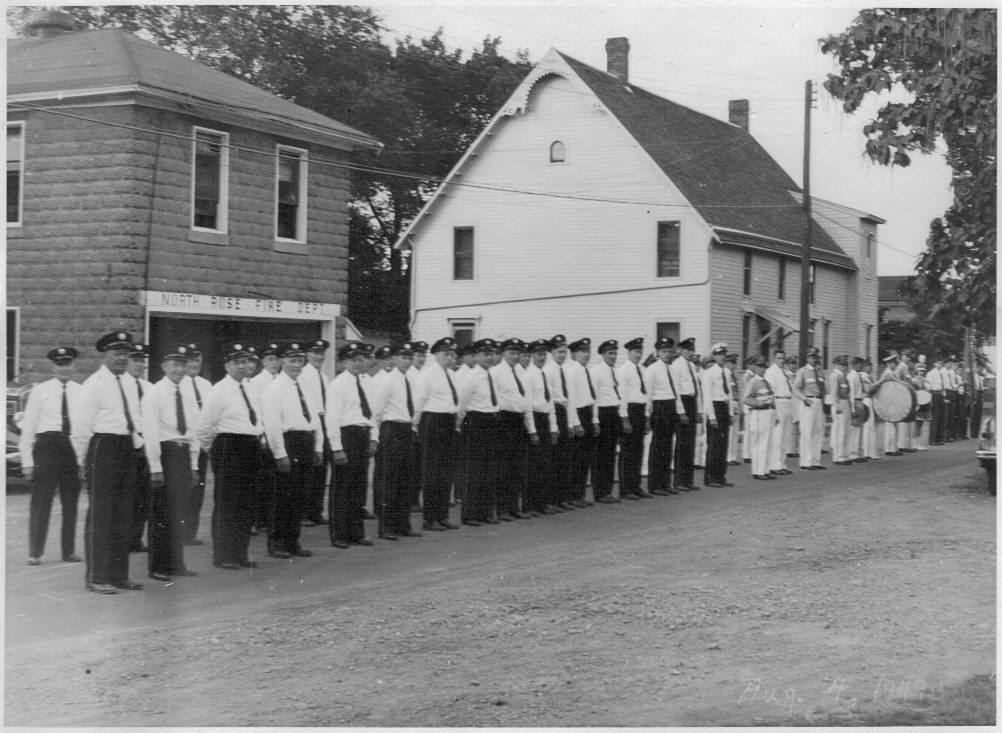
Twenty-three charter members
- ◆Barnes, Roy
- ◆Bowman, William
- ◆Brundridge, Clark
- ◆Calkins, W. H. (Wade Hampton)
- ◆Chaddock, W. B. (Winfield Bayrd)
- ◆Clark, George
- ◆Dickinson, A. C. (Arthur)
- ◆Dickinson, R. D. (Robert)
- ◆Drury, B. V. (Benjamin Valorus)
- ◆Gaffield, Charles
- ◆Galloway, Fletcher
- ◆Hennessey, J. F. (John Francis)
- ◆Lundergun, William
- ◆Mills, Robert
- ◆Miner, Howard C.
- ◆Peterson, C. O. (Clifford Olin)
- ◆Payne, Harry
- ◆Sears, Lawrence
- ◆Stone, Homer
- ◆Tibbets, D. Ross
- ◆Timmons, Frank
- ◆Warner, Hayes
- ◆Worden, Merritt
Charter and early company officers
In May 1915 a meeting was held in the office of H. C. Miner, who — along with his father — was an enthusiastic advocate for forming a volunteer fire department in North Rose. Eight men attended that first gathering, and the following officers were elected: Chief R. D. Dickinson; Assistant Chief Clare Peterson; and Secretary-Treasurer H. C. Miner. One week later another meeting was held, and thirty-two men signed the roll. The new organization adopted the name North Rose Chemical Company.
The members voted to purchase uniforms, personally obligating themselves to the debt — a clear demonstration of their faith in the fledgling department. On July 4 of that same year the community held a large celebration which raised $500 above expenses, placing the department on solid financial footing.
On May 4, 1917, a Hook and Ladder Company was organized with twenty-seven men under President H. E. Patrick and Secretary Seth C. Oaks. Chief Dickinson and the original company welcomed the new unit warmly; wartime conditions soon forced the two companies to consolidate.
By 1919 the department had grown to fifty members and maintained a pleasant club room on the second floor of its Caroline Avenue building.
- Chief
- H. E. Patrick
- First Assistant Chief
- R. D. Dickinson
- Second Assistant Chief
- Ross McOmber
- President
- H. A. Tellier
- Vice President
- C. D. Dillingham
- Recording Secretary
- Charles Dean
- Financial Secretary
- Ray Harris
- Treasurer
- Lloyd Marshall
- Trustees
- B. V. Drury and James Lundergan
- Drill Master
- Rev. O. D. Dutcher
The industry behind the alarm
Prominent families and industry leaders sustained the financial base of North Rose through the late nineteenth and early twentieth centuries. farmers, developers, bankers, investors, cold storages, evaporators, canneries, wholesalers and merchants provided economic stability. Without these industries there would have been limited growth in North Rose — and growth and prosperity are precisely what fueled the need for a fire department. Investors and residents alike wanted to protect their families and their assets.
- John Clarence AldrichFarming; senior member of the Aldrich-Skutt Produce Co.
- George Catchpole (1830–1902)Prominent fruit farmer; five terms as Republican Rose Supervisor.
- Edwin Watson Catchpole (1858–1951)Farming — a "pioneer."
- Charles Garlic (1863–1933)General store (1920), real estate (1910), general merchandise dealer.
- Traver Henry Garlic (1893–1958)Merchant and postmaster.
- Otis Albion Gray (1882–1970)Hardware and contracting.
- John Martin Gray (1877–1968)Postmaster, retail hardware merchant.
- Alvin Gray (1884–1921)Carpenter; built many houses in North Rose and surrounding communities.
- John Hill (b. 1855, Ireland)Cold storage, farming, bank president, produce dealer.
- Frank John Hill (1878–1942)Farmer, storage manager, proprietor of cold storage.
- Lloyd MarshallGeneral Storage and Ice Co., general manager and director.
- Howard MinerPublishing and advocacy; editor of the Advocate.
- M. E. NewberryMerchant and undertaker.
- Charles Wilson OaksLumber and paints.
- Orrin Alexander SkuttRed kidney beans and grains — drying and distribution.
- Edward Adrian Salter (1880–1948)Cannery, bank president, honorary President of the Salter Hose Co.
- George Henry Quereau (1846–1918)Retail merchant.
- Frank QuereauMerchant and Huron farmer.
- Ross QuereauMerchant.
- Addison WeedFarmer, fruit grocer, bank president.
- Joseph Donald WelchNorth Rose Cold Storage manager.
- Thomas B. WelchHardware, postmaster, bank president; pioneer of dried fruit processing.
- Irwin Laverne Wilson (1853–1936)Farming; founder and builder of General Cold Storage and Ice.
M. C. Hall, John Hill, Thomas Welch, Addison Weed
I. Laverne Wilson, Edward Hay, Irving Colburn, Orrin A. Skutt — purchased North Rose Cold Storage in 1947.
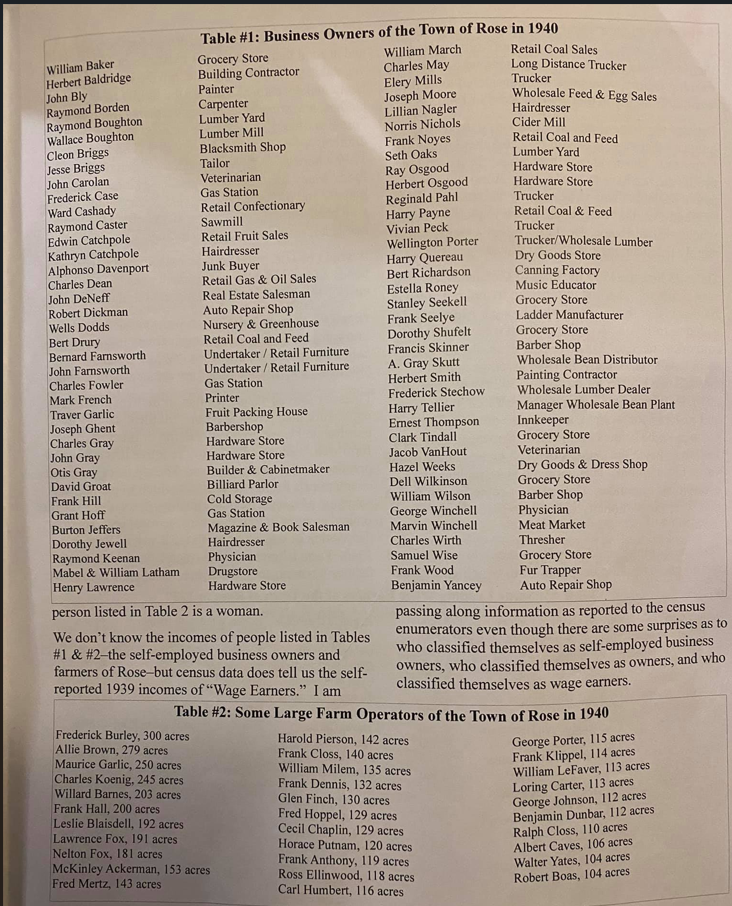
Although farming remains the dominant economic force, the industrial and service sectors that once supported the community have steadily diminished or disappeared: general stores, retail furniture, oil and coal suppliers, fertilizer distribution, ladder manufacturing, banks, barber shops, canning factories, cold-storage facilities, drug stores, service stations, churches, diners, wholesale bean dealers and trucking companies.
Buildings once central to daily commerce now stand vacant or repurposed, and their absence has contributed to an observable decline in the commercial and social vitality that once defined North Rose.
The attempt to incorporate
In the late autumn of 1958 the members found themselves at a turning point. Their organization had long been a pillar of the community — a place where members gathered, friendships formed, and volunteers stood ready to help anyone who suffered loss or injury through fire. As one line in the record states, their purpose was "to promote a spirit of friendship and benevolence among its members and to assist the welfare of one another."
But now they wanted something more permanent: a legal foundation that would allow them to own land, build a social hall, and secure the future of their fellowship. In November 1958 their lawyer, George Thomas, drafted a request for incorporation and submitted it to Justice Charles B. Brasser of the Supreme Court Chambers, Wayne County.
A special meeting followed. President James Betts passed the motion to incorporate before thirteen members; they voted unanimously to proceed. The trustees would serve as directors. War bonds and insurance policies would be updated. The company would be known as North Rose Fire Department, Inc.
By December, Judge Brasser approved the certificate — conditionally. The Town Board of Rose needed to act under Section 11, Subsection 4 of the Membership Corporations Law, and the matter moved to the New York Secretary of State.
January brought complications. On January 9, 1959, the Department of State returned the certificate with three unmet requirements. The lawyer explained that incorporation was intended solely to hold property and build a social hall — "separate from Fire district and their firefighting functions." The State was unmoved: if the group did not intend to incorporate as a fire corporation, the certificate must be rewritten as a purely social organization. Another certificate was submitted on January 16 and rejected on January 19. The State recommended changing the name entirely.
Spring arrived with no resolution. Letters went back and forth — to Judge Brasser, to the Department of State, to the Town Board. On May 15, 1959, the department made yet another attempt. And then the trail goes quiet.
Newspaper Articles
Press coverage of the North Rose Fire Department — titled articles and newspaper pages preserved from the archive.
Newspaper Articles