A living collection
This section is being built as a home for the stories, photographs, and recollections that members, families, and neighbors want to share. If you have a memory of the North Rose Fire Department — a call, a parade, a training night, a family tradition — we hope to make it easy to preserve it here.
Check back as this collection grows. In the meantime, the member narratives on the main Members page offer a first look at the department through the eyes of those who served.
Warren Baldridge and the ruptured hose
On December 20, 1963, firefighter Warren Baldridge suffered one of the most serious injuries in the history of the North Rose Fire Department when a charged hose ruptured beneath him at a working fire in Wolcott, New York. While operating the pumper, vehicles continued driving over the pressurized line, and as Baldridge stepped across it, the hose split with such force that it launched him five to six feet into the air — high enough for him to momentarily find himself level with the truck’s gauges — before gravity brought him down hard, resulting in so many fractures that Dr. Hoople at Wolcott Hospital stopped counting and recorded them simply as “multiple.”
With no hospital beds available in Wolcott, Sodus, or possibly Newark, Baldridge was sent home on a stretcher to recover under his wife’s care, spending weeks or months unable to work and relying partly on Workers’ Compensation and partly on his wife’s income while he healed.
Though once remembered by firefighter Jack Marshall, the incident has largely faded from departmental memory, surviving today primarily through the recollections of Baldridge’s sons as a stark reminder of the hazards faced by rural volunteer firefighters in the 1960s.
Speas Vinegar Works Fire — February 1966
David Guthrie tells the story of the Speas Vinegar Works Fire, which occurred during the storm of the century in February 1966. SPEAS Vinegar Works was owned by Ward Bulmann at the time, and Gerald Guthrie was the Fire Chief.
The Blizzard of 1966 in Upstate New York struck from January 29 through February 1, 1966. The most intense and crippling snowfall began on the morning of January 30th and continued almost relentlessly for 36 hours. Syracuse received a record 42.3 inches of snow; Oswego County was hardest hit, with as much as 102 inches in places like Oswego; Rochester recorded 27 inches. Winds gusting between 50 and 100 mph piled snow into drifts as tall as two-story houses, burying cars and blocking roads. The storm followed a record arctic freeze — Syracuse hit -26°F on January 26 — and was fueled by a Nor'easter and intense lake-effect snow.
David recalls that firefighters “literally rolled over a snow drift on North Poplar Street in North Rose to get to Bob Mills’ house next door. Bob owned a bulldozer, but there was no exhaust pipe, and he could not operate it without being overwhelmed by the exhaust. They fabricated a makeshift exhaust pipe from stainless-steel and worked to plow a path to Speas to allow the fire equipment to proceed to the scene.” An apple drying shed was ablaze and was a total loss.
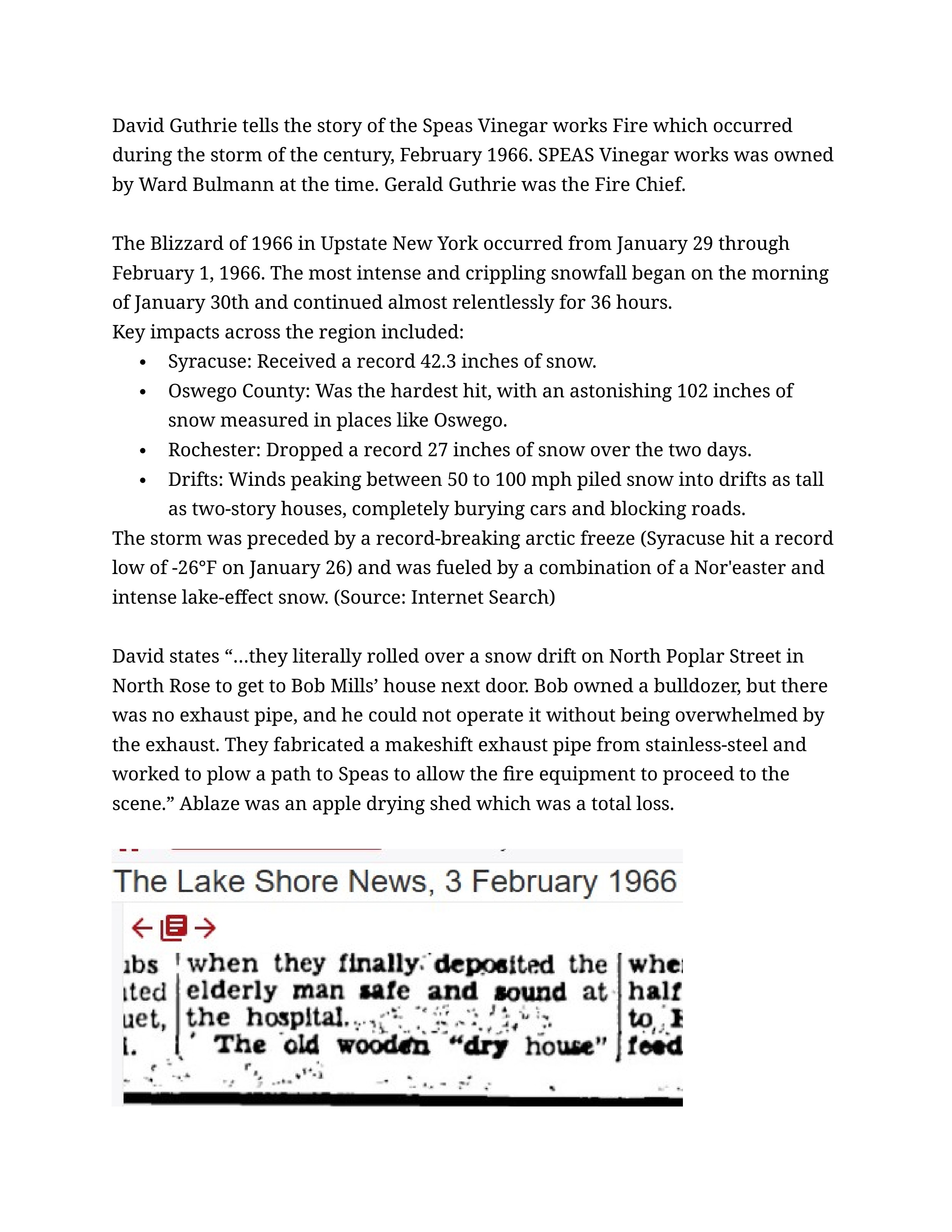
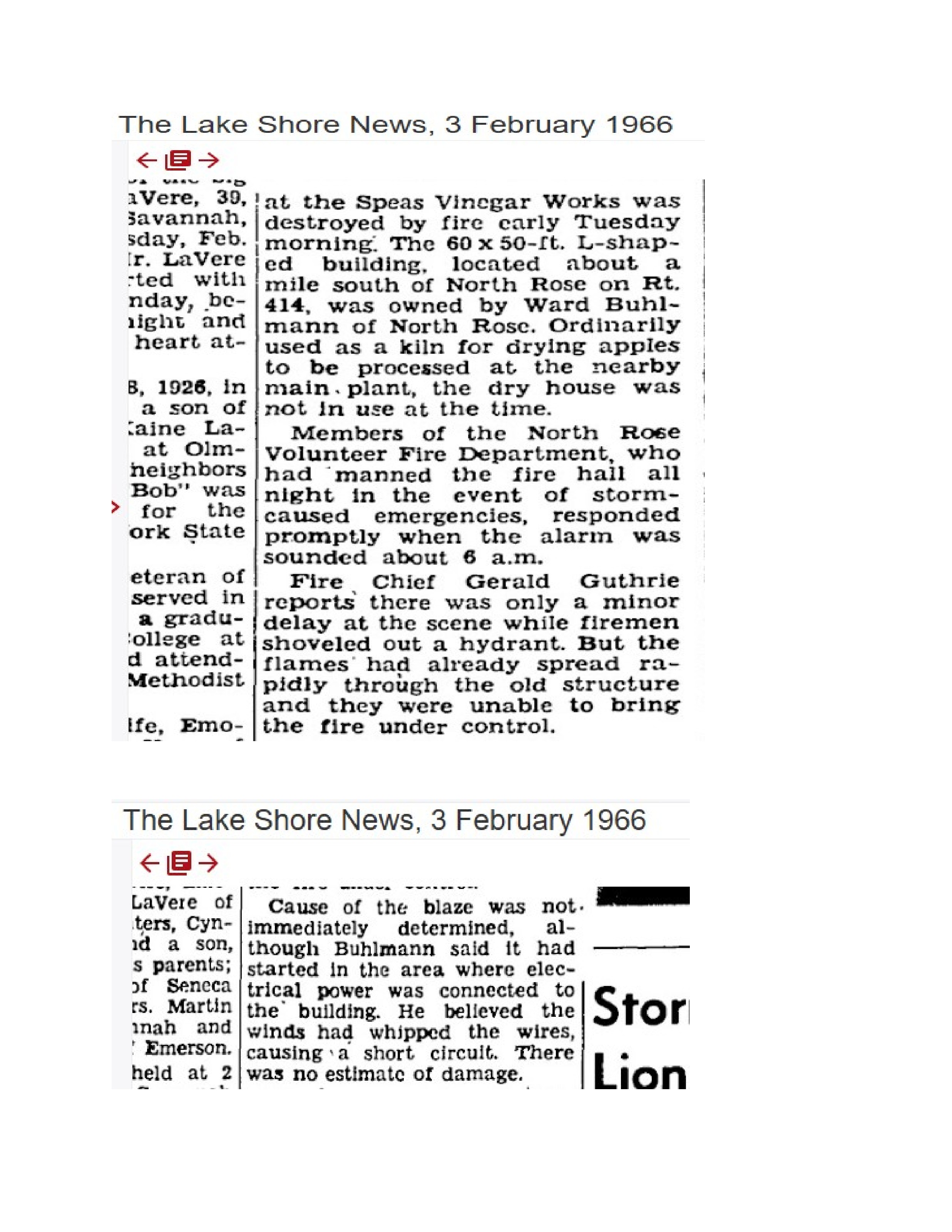
The Lake Shore News, 3 February 1966
The old wooden “dry house” at the Speas Vinegar Works was destroyed by fire early Tuesday morning. The 60 x 50-ft. L-shaped building, located about a mile south of North Rose on Rt. 414, was owned by Ward Buhlmann of North Rose. Ordinarily used as a kiln for drying apples to be processed at the nearby main plant, the dry house was not in use at the time.
Members of the North Rose Volunteer Fire Department, who had manned the fire hall all night in the event of storm-caused emergencies, responded promptly when the alarm was sounded about 6 a.m. Fire Chief Gerald Guthrie reported there was only a minor delay at the scene while firemen shoveled out a hydrant. But the flames had already spread rapidly through the old structure, and they were unable to bring the fire under control.
The cause of the blaze was not immediately determined, although Buhlmann said it had started in the area where electrical power was connected to the building. He believed the winds had whipped the wires, causing a short circuit. There was no estimate of damage.
If you would like to contribute a story, photograph, or memory for future inclusion, please reach out through the About & Acknowledgements page.
Contact the archive